
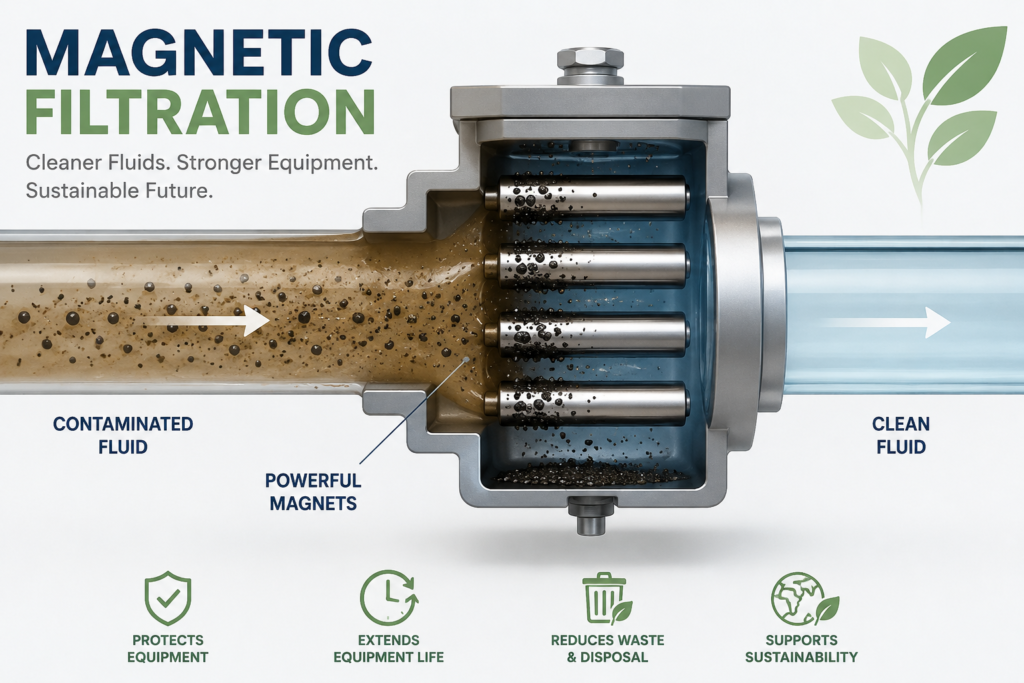

Industrial sustainability is often associated with solar panels, electric vehicles, or carbon capture. But one of the most overlooked environmental technologies is much simpler: magnetic filtration.
Across manufacturing plants, refineries, steel mills, automotive factories, and heavy process industries, tiny metal particles continuously circulate inside oils, coolants, hydraulic fluids, and wastewater streams. Over time, these particles damage pumps, valves, seals, bearings, and process equipment leading to fluid disposal, equipment failures, waste generation, and higher energy consumption.
This is where magnetic filtration is changing the game.
What is Magnetic Filtration?
Magnetic filtration uses high-strength permanent magnets to remove ferrous and metallic contaminants from industrial fluids.
Instead of relying only on disposable paper or cartridge filters, magnetic systems attract microscopic iron and steel particles directly from:
- Lubricating oils
- Hydraulic fluids
- Coolants
- Process water
- Wastewater streams
Modern magnetic systems can even capture sub-micron particles that conventional filters often miss.
The result:
- Cleaner fluids
- Longer equipment life
- Reduced downtime
- Lower waste generation
Why This Matters for the Environment
Most industries still treat filtration as a maintenance activity.
But companies like TrueCan Industrial Technologies are positioning filtration differently: as an asset protection and sustainability strategy.
That shift is important.
Traditional disposable filtration systems generate:
- Large quantities of contaminated filter waste
- Frequent oil and coolant disposal
- Higher maintenance emissions
- Increased industrial waste to landfill
Magnetic filtration reduces many of these problems because the magnetic elements are reusable and require minimal consumables.
How TrueCan Technology Supports Sustainability
TrueCan Industrial Technologies focuses on engineered magnetic separation systems for industrial applications.
Their systems are designed to:
- Extend machinery life
- Improve fluid cleanliness
- Reduce fluid replacement frequency
- Lower maintenance downtime
- Recover reusable metal fines
In real industrial environments, this directly contributes to:
- Reduced industrial waste
- Lower energy consumption
- Less oil disposal
- Reduced spare parts consumption
- Improved resource efficiency
This aligns strongly with modern circular economy principles where industries aim to maximize the life of materials, fluids, and equipment instead of constantly replacing them.
Beyond Filtration: Circular Economy in Action
Magnetic filtration is also a hidden enabler of the circular economy.
Recovered metal particles can often be recycled instead of becoming hazardous waste. Cleaner oils and coolants remain usable for longer periods, reducing raw material demand and transportation emissions.
For industries under ESG and Net Zero pressure, this creates measurable environmental value:
- Less landfill waste
- Reduced carbon footprint
- Lower chemical consumption
- Improved operational efficiency
Studies from industrial filtration providers show magnetic systems can significantly extend fluid life while reducing disposable filter use.
Industries Where Magnetic Filtration is Growing
Magnetic filtration is increasingly used in:
- Steel manufacturing
- Automotive machining
- Mining operations
- Fertilizer and chemical plants
- Power generation
- Industrial wastewater treatment
- Hydraulic systems
For process-heavy industries like fertilizers, refining, and chemicals, cleaner circulating fluids also improve pump reliability and reduce unplanned shutdowns an operational benefit with direct environmental impact.
The Bigger Environmental Agenda
Sustainability is not only about building new green technologies.
Sometimes the biggest environmental gains come from improving the systems industries already use every day.
Magnetic filtration represents that type of innovation:
- Practical
- Scalable
- Low-energy
- Waste-reducing
- Industry-friendly
As global manufacturing moves toward resource efficiency and cleaner production, technologies like those developed by TrueCan Industrial Technologies may quietly become a critical part of the future sustainable industrial ecosystem.





Thanks